

Malicious Intent: Five Years After My #MeToo Essay
Looking back on the Sexual Assault Awareness Month that changed everything — and what it all means today.


Let’s cut to the chase. Five years ago, I posted an essay on Facebook regarding my experiences with sexual violence and emotional abuse as a woman in her early twenties. What started as a therapeutic journal entry to warn others about predatory tactics evolved into something I could have never imagined. This decision altered my life in ways I’m still grappling with. You see, I was sued for writing that essay.
Then I kept writing.
In fact, since then I’ve written about 150 articles — the majority of which have been related to abuse of power, coercive control, and rape culture in the media and politics. I would never credit such a horrific series of unnecessary events in my life, but I must aknowledge that they were the impetus for me to uncover the voice a younger me had kept buried.
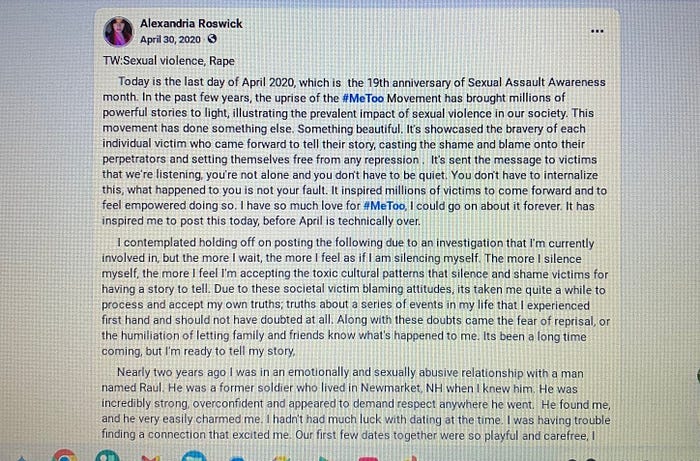
I’m not claiming that the events thickened my skin or transformed me for the better. I find this mindset ridiculous and, in most cases, harmful. The tragic events occurred, and I reacted by pulling up every ounce of strength that was already within my body. Then I utilized it in a way that only I could.
April 2020 feels worlds away and, at the same time, like it was yesterday. But I was even younger when I met the men discussed in my essay. I had poor self-esteem and undiagnosed neurodivergence, which made dating a minefield of heartbreak.
Much of this heartbreak involved more than just arguments and miscommunication. It involved manipulation, gaslighting, and male entitlement. A few times, it involved physical violence. I wondered if I was the only one experiencing this psychologically torturous flavor of complex disappointment over and over again.
I wrote it all down.
When I published my essay, women responded. Unfortunately, I wasn’t alone. Male violence is a pervasive issue that has become normalized to the point where we seldom treat it with the urgency it deserves. It has been reduced to gossip and headlines. It’s become a breeding ground for comment sections erupting with baseless victim-blaming speculation drenched in bigotry.
American society and culture have a distaste for whistleblowers, especially those in marginalized communities. We wish for everyone to sit down, shut up, and be grateful for the food they are served. We clutch tightly the belief that one day those in power will reward us for a lifetime of submission.
It’s frightening how easily our thoughts can be manipulated by those with authority. The experience of being unbelieved by a largely “progressive” academic community while I was mercilessly dragged through prolonged litigation taught me a few disquieting lessons about humanity.
I wrote them all down.
I learned that when faced with the news that a leader in the community has been accused of horrific crimes, a group's cowardice is often exposed. I learned that people (of all political ideologies) tend to hone in on the accuser’s perceived flaws instead of listening. I learned that himpathy is stronger than the urgency around potential communal violence.
Of course, I’m grateful for the handful of people who were supportive. These were people who either saw through him all along, or had witnessed him behave inappropriately before. Three of his past victims/targets reached out to tell me that they believed me. It meant so much to have this group.
During the 2024 election, I remember hearing every liberal political commentator slam Trump supporters for voting-in a convicted rapist. This “gotcha moment” was interesting to me. Of course, the sentiment is technically correct. But is that all it was? Words? Talk? Gotcha!?
I wonder how any of these liberals would react to the news that a subordinate has accused their friend of misconduct. I wonder if their “believe victims” mantra is limited to online “advocacy”.
The truth is that abuse is not a simple issue to understand, which is why we need to talk about it a lot more than we currently do. Whether you see it or not, it’s happening everywhere.
Through my writing in the last five years, I’ve aimed to force my readers into asking themselves uncomfortable questions. Because these situations are real and common, I would prefer it if more people were better prepared to face them.
I want people to consider how they would react if their charming coworker/neighbor/pastor was accused. What if it was the friend who smiles and greets you every morning, frequently buys you a coffee, or maybe once wrote you a letter of recommendation and got you a promotion? Would your mind immediately venture to victim-doubting territory?
That’s exactly how and why this all works.
When I state that abusers appear kind and are well-liked by people around them, most understand exactly what I mean. It seems pretty basic, right?
Well, in practice, even if you know this, there are a lot of biases to navigate around if you want to respond to news of allegations without victim blaming. Your composure might not occur to you if you are emotionally attached or dependent on the status of the alleged abuser. You will likely defer to the most simple coping mechanism: denial.
Suddenly, this well-known fact about abusers couldn’t possibly apply to your pal.
Logic and reasoning matter less when you are understandably conflicted about a socially inconvenient alleged truth. It’s human to have these doubts. But, did you know, you don’t have to express them out loud?
Reacting in a way that could potentially harm a victim might not be in line with your values, but you do it anyway because you don’t want to appear as someone who associates with predators. I understand the delicacy of the ego bruise dealt by an accuser signifying to others that you were tricked.
It’s crossed my mind, even after being on the receiving end of it many times, that most people don’t intend to victim blame. I have reached a point where I can allot some grace here.
That being said, I’m aware that the road to rape culture has been paved with many thoughts and prayers and #believesurvivors.
Good intentions are meaningless to those who’ve had to survive abuse on top of shame at the hands of people they looked to for protection and support. But I strongly believe we can improve all of this. We can decide to build safer communities, and it doesn’t have to be difficult.
It starts with us all getting comfortable with a few disturbing ideas.
1) There is no palatable quality or physical attribute that can eliminate someone from being a predator. It could be anyone–especially the ones many least expect.
2) Dangerous people leverage social structures to build up rock-solid reputations and strategically play off of existing biases surrounding women, people of color, or whistle-blowers from any marginalized group to control the narrative and avoid blame.
3) Manipulative tactics used by abusers are some of the same used by intelligence agencies to interrogate detainees. They are what cults use to indoctrinate recruits. It works.
4) Statistically, we have all unknowingly contributed to an abuser’s smear campaign at least once in our lives.
Sit with these. Release any guilt you feel after one brief minute. It’s not what matters here. We always have the chance to do better.
We need to encourage communal truthtelling through daily purposeful social action. This includes any small effort you make to curate a welcoming space for all.
We should be concerned about the safety of our community members and we should prioritize it over most other things. Being progressive does not stop at the perception of what is right. It’s not about saying the correct words. It’s not about what you can get out of siding with the right person. It’s certainly not about convenience.
Many times it is a matter of life or death. Remember that the word survivor is used for a reason.
If people took five minutes to fact-check myths about attention and fame-seeking that we’re fed about survivors, they’d understand it is not in an individual’s best interest to come forward with their story. It is in the best interest of the community. Truth-tellers make sacrifices for this good.
The Facebook post that I was sued for, the “malicious libel”, the “smear campaign”, has barely reached 500 views to this day. Most of those views I assume are from my rapists and a handful of lawyers. There was no monetization. There was no book deal, cover story or interview on Good Morning America. My social media following did not grow nor did my career explode.
The attorneys concocted a simple narrative — one I’m sure they’ve written hundreds of times before — but it was never about any of that stuff. It was about punishment.
I say this all as someone who will always encourage women to speak out, but I’d never do so without first revealing the possible (unjustified) consequences of a decision like that.
If you write an essay about your sexual assault, you can get sued even if you do not mention names. You may not be believed. You may be harrassed and your property may be vandalized by people who don’t know how to handle their denial properly. It happened to me. It happened to Amber Heard. It has happened in your state and city.
These are the ways that victims are threatened into silence on a daily basis.
These cases seldom end in justice because they require re-traumatization for each survivor, which is not something that can ever be quantified or re-paid. I am chronically ill and disabled due to this compounded trauma, which has affected my employment status. I am struggling to afford the medical care I know I need, which makes the process of diagnosis feel incredibly disjointed and inconclusive.
If my lawyer didn’t offer to take my case pro bono, I would likely be in debt for the rest of my life. If we went to court and lost, I would have had to file for bankruptcy.
I miraculously dodged some impossible decisions that many survivors have no choice but to make. In that sense, I have to admit that I am privileged. As shocking as you believe my story is, there are thousands of victims in the world right now who don’t have computers or iPhones to post about their more dire circumstances.
If you are currently reading my words, I urge you to always consider the effects of trauma on the brain before making generalizations about survivors. Never forget that they can appear to act “abnormally”. They can be angry, depressed, cynical, moody, outspoken, silent, jittery, or frozen stiff.
Victims can even be rude, obnoxious people. They can be bad friends or disappointing co-workers. They can be anyone or anything you don’t like. Listen to their stories anyway.
Being imperfect is not a crime.
The harsh discourse and gossip surrounding recent and past high-profile scandals (yes, even the Blake Lively case) show that we still do not take the topic seriously. Victim doubting does not occur in a vacuum — even if it's online. It all feeds rape culture and will deter people from coming forward about serious dangers.
My self-esteem sat at rock bottom for a long while after my assault, but then it skyrocketed beyond levels that had ever been reached. It was because I witnessed myself achieving something that felt impossible. I withstood the pain of the ceaseless use and discard of my body. These men renewed my sense of hope just to demolish it, but I hoped again. I found a beautiful, true love and held onto it.
I began to believe that my words deserved to be read, so I published everything I wrote down.
Still, our settled case resulted in no policy or legislation changes. Although my rapist left the state, the people of that community continue to believe the best of him. I’m not confident that the area is any safer seeing as I’ve been notified of several egregious controversies since then.
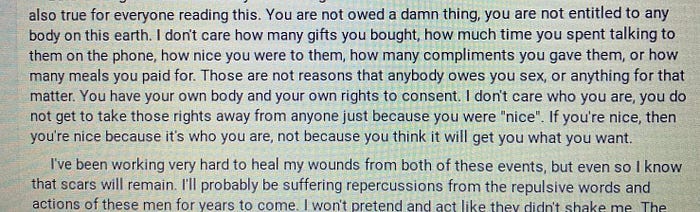
Was it all for the better? Worse? For nothing? Everything? I haven’t made up my mind and who knows if I ever will, but I know without a doubt that I’ll never regret speaking my truth.
It’s been five years. If anybody is expecting me to say I’m over it, I’m not, and I don’t think that’s wrong. Healing is a nonlinear process that feels different every day, so I do my best to stay present and enjoy life living as my authentic self, even when living sucks. Even on the days when I wake up and my authentic self feels like a stranger. I’m glad I’m not numb to it all because that leftover rage is often what fuels my passion to continue writing.
And continue I will.
To any victims who think they should have some silver lining or grand takeaway after all the horrors faced: you don’t have to feel any way about it. You don’t have to have a redemption arc. You don’t have to have anything to show for it besides air in your lungs.
You certainly don’t have to pretend to be thriving if you’re not. A lot of the “healing” we see on social media is for aesthetics. Those with PTSD face numerous obstacles throughout life due to their symptoms, even years beyond the event.
You have survived the unimaginable and that makes you a goddamn warrior.
This retrospective has turned into a disorganized rant about all of the societal gripes and warnings I’ve been repeating for years. Maybe it makes for an inconsistent read, but I’m no longer ashamed of being imperfect, which I count as progress.
Dear reader, I don’t know the half of what you’ve been through, but I know you could’ve let it turn you into a villain — as so many traumatized men seem to. You’re worlds stronger than all of them. That is an accomplishment to be proud of forever, and I think you should scream it from the rooftops.
For more of my thoughts on this topic, I’ve written extensively about the abuse of power imbalance, inappropriate relationships with minors, love-bombing, gaslighting, and other red flags to look out for. I’ve also written about how you can be of assistance if you suspect your friend/ family member/co-worker/neighbor is in an abusive relationship or at risk of getting into one.
To support my writing, consider buying me a cup of coffee! For poetry, follow me on TikTok or Instagram.